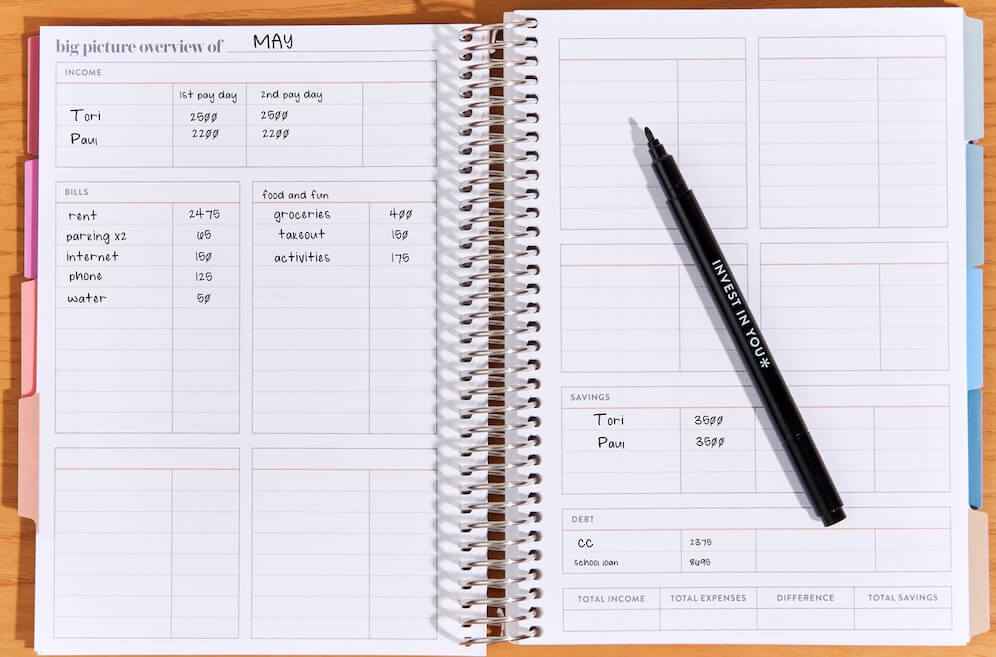
Most people go into salary negotiations with no data. They ask for what they think they deserve. Or what their friend makes. Or what Glassdoor says. And they get rejected because they cannot articulate why they need that number. I am going to teach you a better way. Use your budget.
Your budget is the most powerful negotiating tool you have. Because it is personal. It is specific. It is grounded in reality. When you walk into your boss's office and say, "I need $68,000 because that is what my budget requires to live in Denver and save for retirement," you are not making a demand. You are stating a fact. Facts are harder to argue with than feelings.
Here is how it works. Step one. Build your actual budget. Not a fantasy budget. Your real one. Rent, groceries, utilities, transportation, insurance, debt payments, healthcare, childcare if you have kids, and savings goals. Use the monthly budget calculator to get precise numbers. Know exactly what you spend.
Step two. Add your savings goals. Emergency fund. Retirement. Maybe a down payment. Maybe paying off student loans. These are not optional. They are requirements for financial health. If your budget shows you need $4,200 a month to survive, but you also need $500 a month for savings, your real target is $4,700 a month after taxes.
Step three. Reverse-engineer your salary. If you need $4,700 a month after taxes, that is $56,400 a year net. In Colorado, with a 4.4% state tax and federal taxes, you need roughly $75,000 gross to take home $56,400. That is your number. Not a guess. A mathematical necessity.
Step four. Research the market. Use Glassdoor, PayScale, and local job postings. What do people in your role make in Denver? If the range is $65,000 to $85,000, and your budget says you need $75,000, you are in the sweet spot. You can justify your ask with both personal need and market data.
📊
Monthly Budget Calculator
Build a zero-based budget that accounts for every dollar coming in and going out.
All data stays in your browser — we never see it.
Step five. Make the ask. But do not just say a number. Say the story. "I have done the math. My budget requires $75,000 to cover my essential expenses in Denver and meet my savings goals. Based on market research for this role, that is within the standard range. I would like to discuss how we can get there."
I had a client, a marketing coordinator named Jamie, who used this exact approach. She was making $58,000. Her budget showed she needed $68,000 to break even with savings. She researched the market and found the range was $60,000 to $78,000. She made the ask with her budget in hand. Her boss countered at $64,000. She countered back at $66,000 with a commitment to take on a new project. They settled at $65,000 with a six-month review for another $3,000. She got $7,000 more than her current salary. Because she had data.
The 50/30/20 calculator helps here too. If your current salary puts your needs at 75%, you can show that you are financially stressed. Employers know that financially stressed employees are less productive, more likely to leave, and less engaged. It is in their interest to pay you enough that you are not drowning.
The savings goal calculator shows what you are missing. If you cannot save for retirement at your current salary, that is a problem. For both you and your employer. Employers want employees who can retire eventually. It is awkward when seventy-year-olds are still working because they cannot afford to stop.
And the emergency fund calculator demonstrates risk. If you have no cushion, one emergency could force you to quit for a higher-paying job. Employers pay retention bonuses for a reason. A raise is cheaper than replacing you.
One more thing. Timing matters. Ask after a big win. After you complete a major project. After positive feedback from a client. When you have leverage, use it. Do not ask when the company just laid people off. Do not ask when your performance review was mediocre. Pick your moment.
⚖️
50/30/20 Calculator
Split your income into needs, wants, and savings with this classic framework.
All data stays in your browser — we never see it.
Also, know your walk-away number. The minimum you will accept. If they cannot meet your budget needs, you need a plan B. Another job. A side hustle. A cheaper apartment. But know the number. Because negotiating without a bottom line is just hoping.
Your budget is not just a tool for managing money. It is a tool for advocating for yourself. Use it. Know your number. Know your worth. And ask for what you need. The worst they can say is no. And if they say no, you know exactly what that costs you. Which means you know exactly what to do next.
🎯
Savings Goal Calculator
Figure out exactly how much to save each month to hit your target on time.
All data stays in your browser — we never see it.
FAQs
How do I use a budget for salary negotiation?
Calculate your exact monthly needs and savings goals. Reverse-engineer the gross salary required. Use this number plus market research to justify your ask.
What if my budget number is higher than the market rate?
Then you need to either reduce expenses, increase skills to qualify for higher-paying roles, or consider a different job or location. Budget data helps you make informed decisions.
When is the best time to ask for a raise?
After a big win, positive performance review, or successful project completion. Avoid asking during layoffs, budget cuts, or after poor performance.
Should I show my actual budget to my employer?
You do not need to show the document. Just reference the numbers. "Based on my financial planning, I need $X to meet my obligations and savings goals."
What if they say no?
Ask for a timeline to revisit. Ask about non-salary benefits like remote work, bonuses, or professional development. Know your walk-away number and have a plan B.
Table: Salary Negotiation Budget Worksheet
| Category | Monthly Need | Annual Need |
|----------|-------------|-------------|
| Rent | $1,600 | $19,200 |
| Groceries | $400 | $4,800 |
| Utilities | $180 | $2,160 |
| Transportation | $300 | $3,600 |
| Insurance | $200 | $2,400 |
| Debt payments | $250 | $3,000 |
| Savings goals | $500 | $6,000 |
| Total needed | $3,430 | $41,160 |
| Required gross salary | - | ~$58,000 |